Secure Storage Architecture Requirements - TDA4VM ADAS ECU
1. Functional Security Concept
1.1 Cybersecurity Goals (CSG)
- CSG-STO-1: All persistently stored secrets (credentials, session/application keys, calibration or configuration data marked confidential) shall be stored encrypted at rest and never held in plaintext on non-volatile media.
- CSG-STO-2: Confidentiality of stored secrets shall be bound to device identity such that a secret extracted from one ECU’s storage cannot be decrypted on another ECU.
- CSG-STO-3: Access to stored secrets and key material shall be restricted per key to authorized hosts/cores, not globally shared across all software on the device.
- CSG-STO-4: A power loss or reset during a secret write shall never corrupt or partially expose a previously stored secret.
- CSG-STO-5: Provisioning (initial write) of long-term secret material shall be a one-time, auditable operation that cannot be silently repeated or overwritten by an untrusted host.
- CSG-STO-6: Compromise or disclosure of one stored secret shall not enable derivation of other, unrelated stored secrets (key separation).
1.2 Functional Security Concept (FSC)
- FSC-STO-1: Anchor confidentiality of every stored secret in a hardware-unique root so extraction from one device yields nothing usable elsewhere.
- FSC-STO-2: Separate keys by purpose and owner so compromise of one secret cannot be leveraged to derive or expose another.
- FSC-STO-3: Make provisioning of long-term secrets a one-time, tamper-evident event, and make every write to persistent secret storage resilient to interruption.
1.3 Functional Security Requirements (FSR)
- FSR-STO-1: A secret shall never be written to or read from non-volatile media in plaintext form.
- FSR-STO-2: Decrypting a stored secret shall require key material that is unique to the originating device and unobtainable from another device’s storage.
- FSR-STO-3: A given secret or key shall be usable only by the specific host/core(s) authorized for it, not by any software running on the device.
- FSR-STO-4: An interrupted write to secret storage shall leave either the previous valid secret or the new valid secret recoverable, never a corrupted or partially exposed intermediate state.
- FSR-STO-5: Initial provisioning of long-term secret material shall be performed at most once per device and shall be verifiable as such.
- FSR-STO-6: Disclosure of one stored secret shall not provide any computational advantage toward recovering another, unrelated stored secret.
2. System Requirements and System Static Architecture
2.1 System entities
- Application/host modules requesting storage of credentials, session keys, calibration/config secrets
- Secure Storage Manager (host-side service selecting the appropriate storage backing)
- TIFS Keyring and DKEK service (System Firmware, runs on DMSC)
- SA2UL crypto engine (DKEK registers, AES-GCM/CBC/ECB, PrivID gating)
- DMSC eFuse-resident factory Key Encryption Key (KEK)
- Extended OTP region (1024-bit customer general-purpose eFuse array)
- Protected NvM/flash partition for bulk encrypted secret blobs
- Manufacturing/service provisioning tool (one-time keyring and OTP provisioning)
2.2 Trust boundaries and interfaces
- Boundary A: Application/host to Secure Storage Manager API
- Boundary B: Secure Storage Manager to TIFS Keyring/DKEK service (TISCI mailbox)
- Boundary C: SA2UL DKEK register boundary, gated by hardware PrivID
- Boundary D: Extended OTP row read/write/lock ownership boundary (single write_host)
- Boundary E: Protected NvM partition to non-secure filesystem/export boundary
graph LR
  App[Application/Host Module] --> SSM[Secure Storage Manager]
  SSM --> TIFS[TIFS Keyring/DKEK Service]
  TIFS --> SA2UL[SA2UL Crypto Engine]
  TIFS --> KEK[DMSC eFuse KEK]
  SSM --> OTP[Extended OTP Region]
  SSM --> NvM[Protected NvM Partition]
  Prov[Manufacturing Provisioning Tool] --> TIFS
2.3 System Requirements (SYSR)
- SYSR-STO-1: The Secure Storage Manager shall route every storage request to either the DMSC-anchored key hierarchy (KEK/DKEK) or the Extended OTP backing, never persisting a raw secret in the Protected NvM partition without one of these two protections.
- SYSR-STO-2: The Manufacturing/service provisioning tool shall be the only system entity permitted to invoke keyring import and Extended OTP provisioning across the system.
- SYSR-STO-3: Each trust boundary crossing (Boundary A, B, C) shall carry only key-ID handles or ciphertext, never raw key material, except during the one-time provisioning boundary crossing.
- SYSR-STO-4: The system shall guarantee that a secret extracted from the Protected NvM partition of one ECU instance is not decryptable using another ECU instance’s storage stack, since the underlying KEK differs per device.
3. Technical Security Concept
3.1 Technical Security Concept (TSC)
- TSC-STO-1: Anchor all higher-layer secret protection in a device-unique hardware root key that never leaves the SoC.
- TSC-STO-2: Derive per-purpose, per-host storage keys from the hardware root key using a standard KDF with domain-separating label/context inputs, instead of reusing one key for all secrets.
- TSC-STO-3: Reference keys by opaque key-ID handles for crypto operations rather than passing raw key material across host/firmware boundaries.
- TSC-STO-4: Enforce one-time, signed-and-encrypted bulk provisioning of the long-term symmetric keyring; reject any re-import attempt.
- TSC-STO-5: Use crash-consistent (write-ahead/double-buffer) writes for the protected secret storage partition.
- TSC-STO-6: Gate small, extremely high-value secrets (for example, a per-unit provisioning token) behind row-level, lockable OTP storage separate from the bulk encrypted flash partition.
3.2 Technical Security Requirements (TSR)
- TSR-STO-1: Use the DMSC-resident, factory-provisioned Key Encryption Key (KEK) - a 256-bit device-unique key burned into eFuse and reachable only through the DMSC AES engine’s register interface (no DMA path) - as the storage root of trust.
- TSR-STO-2: Derive a Derived KEK (DKEK) per host/purpose using a CMAC-based counter-mode KDF (NIST SP 800-108) over a label plus context (limited to 41 bytes combined by the TISCI message size) plus the requesting host ID, via
TISCI_MSG_CRYPTO_GET_DKEK/TISCI_MSG_CRYPTO_SET_DKEK. - TSR-STO-3: Prefer the SA2UL-resident DKEK approach (
TISCI_MSG_CRYPTO_SET_DKEKprograms SA2UL DKEK registers, gated by the SA2UL DKEK PrivID register and theUSE_DKEKsecurity-context flag) over the host-supplied-raw-DKEK approach wherever hardware acceleration is available, since the former never exposes DKEK outside SA2UL. - TSR-STO-4: Release SA2UL DKEK registers via
TISCI_MSG_CRYPTO_RELEASE_DKEKimmediately after use, closing the window in which secure and non-secure software sharing a PrivID on the same core could reuse a still-programmed DKEK. - TSR-STO-5: Provision up to 6 AES-256 application secrets via the TIFS symmetric keyring (
TISCI_MSG_KEYRING_IMPORT), each referenced by a 1-254key_idwith akey_rightsbitmask (image_enc_dec/CSP_decrypt/HKDF) limiting permitted operations. - TSR-STO-6: Encrypt/decrypt bulk secret blobs via the TIFS Cryptographic Services (CSP) API using AES-GCM (preferred, produces an authentication tag) referencing a keyring
key_idrather than embedding raw key material in the request context. - TSR-STO-7: Store a small set of irrevocable, high-value per-unit secrets in the 1024-bit Extended OTP region, with a single designated
write_host, rows marked secure (value withheld from the TISCI read response, usable only to set up crypto contexts) or non-secure, and soft-locked (TISCI_MSG_SOFT_LOCK_OTP_WRITE_GLOBAL, until reset) or permanently locked (TISCI_MSG_LOCK_OTP_ROW) once provisioning is complete.
4. Hardware Requirements and Hardware Static Architecture
4.1 Hardware elements
- DMSC eFuse array: factory-random 256-bit KEK, marked read- and write-protected
- DMSC AES engine: register-interface-only path to the KEK, no DMA access
- SA2UL: DKEK registers with PrivID gating, AES-GCM/CBC/ECB engine, HMAC/CMAC
- Extended OTP array: 1024 bits, row-granular hardware write-lock latching
- Protected NvM/flash partition with an atomic/recoverable write path
- TISCI mailbox IPC transport (host cores to DMSC/TIFS for all key-management messages)
graph LR
  Host[Host Core] --> Mbox[TISCI Mailbox IPC]
  Mbox --> DMSC[DMSC Cortex-M3 SYSFW]
  DMSC --> AES[DMSC AES Engine]
  AES --> EFUSE[eFuse KEK Array]
  DMSC --> SA2UL[SA2UL DKEK/Crypto Engine]
  DMSC --> OTP[Extended OTP Array]
  Host --> NvM[Protected NvM/Flash Partition]
4.2 Hardware Requirements (HWR)
- HWR-STO-1: KEK is burnt once at TI factory, never retained in any database or manufacturing tester, and reachable only through the DMSC AES engine register interface
- HWR-STO-2: SA2UL enforces PrivID-based gating of DKEK register usage independent of secure/non-secure or privileged/user attributes
- HWR-STO-3: Extended OTP rows support independent write-lock latching in hardware, enforced even across warm/cold resets once permanently locked
- HWR-STO-4: Protected NvM partition write path guarantees atomic/recoverable commits across power loss
5. Software Requirements and Software Static & Dynamic Architecture
5.1 Software blocks
- Secure Storage API (store/retrieve/provision secret)
- Backing selector (chooses extended OTP vs symmetric keyring/DKEK-encrypted NvM by size/criticality/lifetime)
- Keyring import handler (one-time
TISCI_MSG_KEYRING_IMPORTclient) - DKEK service client (get/set/release DKEK)
- Extended OTP access service (read/write/lock OTP row)
- CSP encrypt/decrypt client (AES-GCM against a keyring
key_id) - Crash-consistent NvM storage driver
graph LR
  API[Secure Storage API] --> Sel[Backing Selector]
  Sel --> KR[Keyring Import Handler]
  Sel --> DK[DKEK Service Client]
  Sel --> OTPsvc[Extended OTP Access Service]
  DK --> CSP[CSP Encrypt/Decrypt Client]
  CSP --> Drv[Crash-Consistent NvM Driver]
5.2 Software Requirements (SWR)
- SWR-STO-1: Backing selector chooses extended OTP vs symmetric keyring/DKEK-encrypted NvM based on secret size, criticality, and lifetime
- SWR-STO-2: Keyring import handler enforces one-time-import semantics and validates
key_rightsbefore shipping - SWR-STO-3: DKEK service client always releases DKEK after use (Approach 1) or firewalls the raw DKEK in its own memory (Approach 2)
- SWR-STO-4: CSP encrypt/decrypt calls reference a keyring
key_id, never passing raw application secrets into DMSC/SA2UL registers except during initial keyring/OTP provisioning - SWR-STO-5: Storage driver performs write-ahead/double-buffer commits and verifies the AES-GCM tag on read-back before releasing a secret to the caller
5.3 Secure storage provisioning and runtime store/retrieve sequence
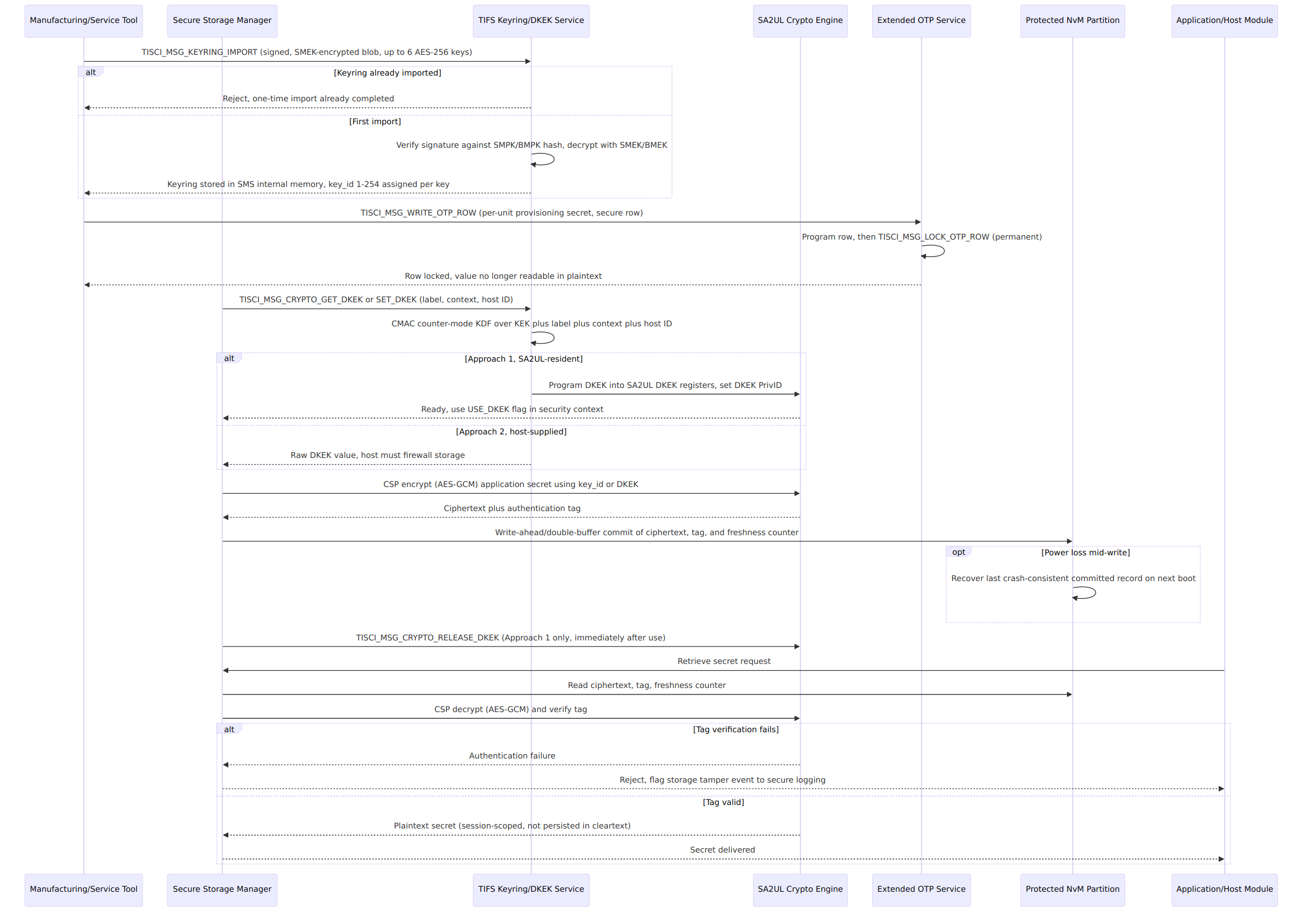
Mermaid source (for editing/regeneration)
sequenceDiagram
  participant Mfg as Manufacturing/Service Tool
  participant SSM as Secure Storage Manager
  participant TIFS as TIFS Keyring/DKEK Service
  participant Y as SA2UL Crypto Engine
  participant Otp as Extended OTP Service
  participant Nv as Protected NvM Partition
  participant App as Application/Host Module

  Mfg->>TIFS: TISCI_MSG_KEYRING_IMPORT (signed, SMEK-encrypted blob, up to 6 AES-256 keys)
  alt Keyring already imported
    TIFS-->>Mfg: Reject, one-time import already completed
  else First import
    TIFS->>TIFS: Verify signature against SMPK/BMPK hash, decrypt with SMEK/BMEK
    TIFS-->>Mfg: Keyring stored in SMS internal memory, key_id 1-254 assigned per key
  end

  Mfg->>Otp: TISCI_MSG_WRITE_OTP_ROW (per-unit provisioning secret, secure row)
  Otp->>Otp: Program row, then TISCI_MSG_LOCK_OTP_ROW (permanent)
  Otp-->>Mfg: Row locked, value no longer readable in plaintext

  SSM->>TIFS: TISCI_MSG_CRYPTO_GET_DKEK or SET_DKEK (label, context, host ID)
  TIFS->>TIFS: CMAC counter-mode KDF over KEK plus label plus context plus host ID
  alt Approach 1, SA2UL-resident
    TIFS->>Y: Program DKEK into SA2UL DKEK registers, set DKEK PrivID
    Y-->>SSM: Ready, use USE_DKEK flag in security context
  else Approach 2, host-supplied
    TIFS-->>SSM: Raw DKEK value, host must firewall storage
  end
  SSM->>Y: CSP encrypt (AES-GCM) application secret using key_id or DKEK
  Y-->>SSM: Ciphertext plus authentication tag
  SSM->>Nv: Write-ahead/double-buffer commit of ciphertext, tag, and freshness counter
  opt Power loss mid-write
    Nv->>Nv: Recover last crash-consistent committed record on next boot
  end
  SSM->>Y: TISCI_MSG_CRYPTO_RELEASE_DKEK (Approach 1 only, immediately after use)

  App->>SSM: Retrieve secret request
  SSM->>Nv: Read ciphertext, tag, freshness counter
  SSM->>Y: CSP decrypt (AES-GCM) and verify tag
  alt Tag verification fails
    Y-->>SSM: Authentication failure
    SSM-->>App: Reject, flag storage tamper event to secure logging
  else Tag valid
    Y-->>SSM: Plaintext secret (session-scoped, not persisted in cleartext)
    SSM-->>App: Secret delivered
  end
5.4 Behavioral requirement focus
- The symmetric keyring can only be imported once; any later
TISCI_MSG_KEYRING_IMPORTattempt is rejected outright, which is what makes provisioning auditable and non-repeatable rather than a silently overwritable operation (CSG-STO-5, TSC-STO-4) - Extended OTP rows carrying per-unit high-value secrets are permanently locked immediately after provisioning, so even a compromised host with write access afterward cannot rewrite or read them back in plaintext (TSC-STO-6, TSR-STO-7)
- DKEK is derived per host/label/context from a KEK that itself never leaves the DMSC AES engine’s register interface, so different ECUs (different factory-burnt KEK) or different callers (different label/context/host ID) never converge on the same derived key - a secret pulled from one device’s flash cannot be decrypted elsewhere (CSG-STO-2, TSR-STO-1, TSR-STO-2)
- Approach 1 (SA2UL-resident DKEK) is released immediately after use via
TISCI_MSG_CRYPTO_RELEASE_DKEK, minimizing the window in which secure/non-secure code sharing a PrivID on the same core could reuse it (CSG-STO-3, TSR-STO-4) - Every stored secret carries an AES-GCM authentication tag; a failed tag check on retrieval is treated as a storage-tamper event and reported to secure logging rather than silently returning corrupted or substituted data (CSG-STO-1, SWR-STO-5)
- Writes to the protected NvM partition are crash-consistent (write-ahead/double-buffer), so a power loss mid-write cannot corrupt or partially expose a previously committed secret (CSG-STO-4, TSC-STO-5)
6. Hardware-Software Interface (HSI)
6.1 HSI elements
- DMSC AES engine register interface: operate-with-KEK path only, no raw-KEK read path exposed to software
- SA2UL DKEK register set and PrivID gating register, accessed only via the
USE_DKEKsecurity-context flag - TISCI mailbox message set:
TISCI_MSG_CRYPTO_GET_DKEK/SET_DKEK/RELEASE_DKEK,TISCI_MSG_KEYRING_IMPORT,TISCI_MSG_WRITE_OTP_ROW,TISCI_MSG_LOCK_OTP_ROW,TISCI_MSG_SOFT_LOCK_OTP_WRITE_GLOBAL - Extended OTP row read/write/lock-status register interface
- Protected NvM controller write-ahead/double-buffer commit interface
6.2 HSI Requirements (HSI)
- HSI-STO-1: The DMSC AES engine’s KEK register interface shall expose no read path to software, only an operate-with-KEK path, so no driver or API may return the raw KEK value.
- HSI-STO-2: The SA2UL DKEK register interface shall be gated by hardware PrivID matching, and software shall treat
USE_DKEKas the only permitted access flag rather than addressing DKEK registers directly. - HSI-STO-3: The TISCI mailbox interface carrying key-management messages shall enforce message-level access control per host, independent of any software-level policy layered on top.
- HSI-STO-4: The Extended OTP row interface shall expose row lock-state (soft/permanent) to software as a queryable status, so the storage driver can detect and refuse writes to an already-locked row before issuing
TISCI_MSG_WRITE_OTP_ROW.
Interview Appendix: Expert Q&A (20 Questions)
The following expert-level Q&A set is intended for interview practice and design review on this topic.
| # | Question | Difficulty | Detailed answer | Evidence |
|---|---|---|---|---|
| 1 | Why must every stored secret be encrypted at rest instead of relying on filesystem or OS-level access control alone? | L1 | Access control at the filesystem level only protects against software that respects the OS’s permission model, but an attacker with physical access, a desoldered flash chip, or a privilege-escalation exploit can bypass that entirely. Encrypting the secret at rest means that even if the raw bytes are extracted from flash, they are useless without the device-specific key material needed to decrypt them. This is the difference between access control, which can be bypassed, and cryptographic protection, which requires breaking the underlying cryptography or obtaining the key. | CSG-STO-1, FSR-STO-1 |
| 2 | Why does the design bind confidentiality to device identity rather than using a single shared key across all ECUs? | L2 | A shared key means that compromising one device’s key compromises every device using that same key, turning a single point of failure into a fleet-wide vulnerability. By deriving encryption keys from a device-unique factory-burnt KEK, a secret extracted from one ECU’s storage cannot be decrypted using another ECU’s key material, since the underlying root differs per device. This confines the blast radius of any single compromise to just the one device. | CSG-STO-2, TSR-STO-1, SYSR-STO-4 |
| 3 | What is the practical difference between the KEK and the DKEK in this design? | L2 | The KEK is the single, factory-provisioned root key burnt into eFuse and never exposed outside the DMSC AES engine’s register interface; it is the ultimate hardware trust anchor. The DKEK is a per-host, per-purpose key derived from the KEK using a KDF with domain-separating labels and context, so different callers or different use cases get cryptographically distinct keys without needing separate hardware roots. This separation means the KEK itself is never directly used for everyday encryption operations, reducing its exposure. | TSR-STO-1, TSR-STO-2, TSC-STO-2 |
| 4 | Why is SET_DKEK generally preferred over GET_DKEK when hardware acceleration is available? | L3 | GET_DKEK returns the raw derived key value to the host, which then becomes responsible for protecting that secret in its own memory space, creating an additional copy of sensitive material outside the crypto engine. SET_DKEK programs the derived key directly into SA2UL’s DKEK registers, so the key value never leaves the hardware crypto engine at all. Minimizing the number of places a secret physically exists is a core security design principle, and the SA2UL-resident approach achieves that whenever the hardware supports it. | TSR-STO-3, CSG-STO-3 |
| 5 | Why is TISCI_MSG_CRYPTO_RELEASE_DKEK called immediately after use rather than leaving the DKEK programmed indefinitely? | L2 | Leaving the DKEK programmed in SA2UL registers longer than necessary widens the window during which other software sharing the same PrivID on the same core could potentially reuse or access the derived key without proper authorization. Releasing it immediately after the cryptographic operation completes minimizes this exposure window, following the principle that a secret should exist in an accessible state for the shortest time necessary. | TSR-STO-4 |
| 6 | Why is the symmetric keyring designed as a one-time, non-repeatable import rather than an updatable key store? | L3 | If the keyring could be silently re-imported or overwritten, an attacker with sufficient access could replace the provisioned application keys with their own, undermining every downstream security guarantee built on those keys. Making the import a one-time, auditable operation ensures that once the legitimate keys are provisioned, no later actor, authorized or not, can silently swap them, and any attempt to re-import is explicitly rejected and observable. | CSG-STO-5, TSC-STO-4, SWR-STO-2 |
| 7 | What is the purpose of the key_rights bitmask on each keyring entry? | L2 | The bitmask restricts what operations a given key can be used for, such as image encryption/decryption, CSP decrypt, or HKDF derivation, rather than allowing any key to be used for any purpose. This enforces least-privilege at the key level: even if application code is compromised, it cannot repurpose a key intended for one function to perform an entirely different cryptographic operation it was never authorized for. | TSR-STO-5 |
| 8 | Why does the design store only a small set of secrets in Extended OTP rather than everything there? | L3 | Extended OTP is extremely limited in size (1024 bits) and each row can be permanently locked, making it ideal for irrevocable, high-value, rarely-changing secrets like per-unit provisioning tokens, but impractical for bulk application data. Using OTP for everything would both exhaust the available space and forgo the flexibility of encrypted NvM storage, which supports much larger volumes of data with crash-consistent writes. The design therefore reserves OTP for the smallest, most critical secrets and uses the keyring/DKEK-encrypted NvM path for everything else. | TSR-STO-7, SWR-STO-1 |
| 9 | What does it mean for an OTP row to be marked secure versus non-secure, and why does that distinction matter? | L2 | A secure row’s value is withheld from the TISCI read response and can only be used internally to set up crypto contexts, whereas a non-secure row’s value can be read back directly. This matters because some provisioned values, like a cryptographic secret, should never be readable in plaintext by any software layer, while other values, like a non-sensitive identifier, are fine to expose. The secure/non-secure distinction lets the same OTP mechanism serve both use cases without accidentally leaking a value that should stay protected. | TSR-STO-7 |
| 10 | Why is a soft lock (until reset) offered in addition to a permanent lock for OTP rows? | L2 | A soft lock provides a way to prevent writes during the remainder of a manufacturing or provisioning session without permanently committing to a value, which is useful if a row needs to be re-verified or re-attempted before final commitment. A permanent lock is the irreversible, production-time decision that ensures the value can never be altered again, even across future resets. Having both options supports a safer provisioning workflow that separates temporarily protecting a value from finalizing it forever. | TSR-STO-7, HSI-STO-4 |
| 11 | Why does the design require crash-consistent (write-ahead/double-buffer) writes for the Protected NvM partition? | L2 | A naive single-location write can be left in a corrupted or partially-written state if power is lost mid-write, potentially exposing a mix of old and new ciphertext bytes or leaving the secret unrecoverable entirely. A write-ahead or double-buffer approach ensures that at any point in time, either the previous valid secret or the fully-committed new secret can be recovered, never an inconsistent intermediate state. This directly protects against a power-loss attack or accidental fault during a write. | CSG-STO-4, TSC-STO-5, HWR-STO-4 |
| 12 | Why is an AES-GCM authentication tag checked on every read-back rather than trusting the stored ciphertext implicitly? | L3 | Ciphertext alone does not prove that the data has not been corrupted or tampered with since it was written; without an authentication check, a bit-flip or deliberate modification could decrypt to a plausible-looking but incorrect plaintext without any error being raised. Verifying the AES-GCM tag on every read ensures that any tampering or storage corruption is detected before the plaintext secret is ever released to the calling application, converting a potential silent-corruption bug into an explicit, logged failure. | SWR-STO-5, CSG-STO-1 |
| 13 | What is the significance of the DMSC AES engine having no DMA path to the KEK? | L3 | A DMA path could allow a peripheral or a compromised software component to potentially access or influence the KEK operation indirectly, bypassing the tightly controlled register interface. By restricting access to a register-interface-only path with no DMA capability, the design ensures that the only way to use the KEK is through the narrowly-defined, audited operate-with-KEK path, eliminating an entire class of potential side-channel or bypass attacks through direct memory access. | TSR-STO-1, HSI-STO-1 |
| 14 | Why does key separation (CSG-STO-6) matter even if each individual key is strong? | L2 | If keys are derived in a way that allows one key’s compromise to reveal information about another unrelated key, an attacker who breaks one secret gains an unfair advantage toward breaking others, effectively reducing the overall security to the weakest link. The KDF-based derivation with domain-separating labels and context ensures that each derived key is cryptographically independent, so disclosure of one secret provides no computational shortcut toward recovering a different, unrelated secret. | CSG-STO-6, FSR-STO-6, TSC-STO-2 |
| 15 | How does the two-backend design (Extended OTP vs. keyring/DKEK-encrypted NvM) reflect a risk-based storage strategy? | L3 | Not all secrets have the same value or lifecycle: a tiny, irrevocable per-unit identity secret has different requirements than a larger, potentially rotatable application key. The backing selector routes each secret to the appropriate protection mechanism based on size, criticality, and lifetime, rather than forcing a one-size-fits-all storage model. This lets the system apply the strongest, least-flexible protection (OTP) only where it is truly needed, while using the more flexible encrypted NvM path for the bulk of application secrets. | SWR-STO-1, TSC-STO-6 |
| 16 | Why is provisioning explicitly restricted to a designated manufacturing/service tool rather than allowed from any host at runtime? | L2 | If any host could invoke keyring import or OTP provisioning at runtime, an attacker who compromises the application software could potentially inject their own key material or overwrite provisioning state. Restricting these operations to a single designated provisioning tool, enforced at the system level, ensures that the security-critical act of establishing trust anchors happens only in a controlled, auditable manufacturing or service context, not as a general-purpose runtime capability. | SYSR-STO-2, CSG-STO-5 |
| 17 | What would be the consequence if trust boundaries carried raw key material instead of key-ID handles or ciphertext? | L3 | Passing raw key material across a boundary means any component or logging mechanism along that path could potentially observe or leak the secret, multiplying the number of places where the key exists in a directly usable form. Using opaque key-ID handles or ciphertext ensures that the actual secret value never needs to cross most boundaries; the receiving component performs an operation using the key by reference rather than obtaining the raw material itself, which drastically reduces the exposure surface. | SYSR-STO-3, TSC-STO-3 |
| 18 | Why does a failed tag verification on retrieval get treated as a tamper event and reported to secure logging rather than a generic error? | L2 | A tag verification failure could indicate either underlying storage corruption or deliberate tampering, both of which are security-relevant and warrant investigation, unlike a routine application error. Treating this as a flagged tamper event ensures that a pattern of failures, which might indicate an attack in progress or hardware fault, is visible to a security monitoring process rather than being silently swallowed as a generic read failure. | SWR-STO-5, secure logging integration |
| 19 | If an attacker fully desolders the flash chip from a decommissioned ECU, what actually prevents them from reading out usable secrets? | L3 | The extracted flash only contains ciphertext protected by keys derived from the device-unique KEK, which itself never leaves the DMSC AES engine and was never stored anywhere outside that specific chip’s eFuse array. Without physically extracting and defeating the eFuse-protected KEK on that same silicon, which is designed to resist extraction, the attacker holds only encrypted bytes with no usable path to the plaintext. This is precisely why anchoring confidentiality in a hardware-unique root, rather than a key derivable from the ciphertext or metadata alone, defeats offline flash-extraction attacks. | CSG-STO-2, TSR-STO-1, FSC-STO-1 |
| 20 | If you had to summarize the secure storage principle in one sentence, what would it be? | L1 | Every persistent secret must be encrypted with a device-unique, hardware-rooted key that never leaves its protected engine, separated by purpose so one compromise cannot cascade to another, and written with crash-consistent guarantees so no fault can corrupt or expose it. | CSG-STO-1 through CSG-STO-6, TSC-STO-1 through TSC-STO-6 |