Vulnerability Analysis and Management Requirements - TDA4VM ADAS ECU
Scope note (this doc adapts the repo’s template deliberately): every other doc in this repo covers a runtime security mechanism on the ECU (boot, JTAG, comms, storage, …). Vulnerability analysis is instead an ISO 21434 continuous cybersecurity activity (monitoring, event evaluation, vulnerability analysis, vulnerability management) that runs across the item’s whole lifecycle and feeds back into those mechanisms. To keep this doc traceable in the same CSG->FSR->SYSR->TSC->TSR-> HWR/SWR->HSI shape as the rest of the repo:
- Section 4 (“Hardware Requirements and Hardware Static Architecture”) is the hardware asset inventory and fingerprinting surface this activity analyzes, not a new crypto engine.
- Section 5 is the tooling/workflow that ingests disclosures and produces risk-treatment decisions, not an always-running runtime security stack.
- This doc’s job is to re-assess and route, referencing the CSG/TSR/HWR/SWR IDs already defined
in this repo’s other nine docs - see the
traceability-matrixskill for how those cross-doc links are built.
1. Functional Security Concept
1.1 Cybersecurity Goals (CSG)
- CSG-VULN-1: Every deployed TDA4VM ECU software/hardware component (DMSC/TIFS, SA2UL crypto stack, R5F SBL, A72 HLOS/application software, third-party libraries) shall be tracked in a component inventory (SBOM) sufficient to determine whether a newly disclosed vulnerability applies to a given fielded configuration.
- CSG-VULN-2: External vulnerability disclosures relevant to any inventoried component (NVD/CVE feeds, TI PSIRT security bulletins, supplier/OSS advisories, internal red-team/pentest findings, coordinated disclosure reports) shall be continuously monitored, not reviewed only at a fixed release cadence.
- CSG-VULN-3: Every vulnerability matched to a fielded component shall be re-assessed using the item’s own TARA vocabulary (asset, damage scenario, threat scenario, attack feasibility, impact rating) rather than adopting a generic third-party severity score unmodified.
- CSG-VULN-4: A vulnerability whose re-assessed risk exceeds the item’s defined risk acceptance threshold shall trigger a tracked risk-treatment decision (mitigate via patch/config change, compensate via a monitoring control, or accept with documented rationale) within a bounded time.
- CSG-VULN-5: Vulnerability status, re-assessment outcome, and risk-treatment decisions shall be traceable to the specific CSG/TSR/HWR/SWR requirement ID(s) they affect across this repo’s other topic documents.
1.2 Functional Security Concept (FSC)
- FSC-VULN-1: Maintain a continuously updated component/version inventory (SBOM) covering firmware, OS, and third-party software, correlated against the same version identifiers (SWREV/KEYREV, image manifest versions) used elsewhere in the boot/OTA/reprogramming chain, so a disclosed CVE can be matched to exactly the fielded configurations it affects.
- FSC-VULN-2: Run every matched disclosure through the item’s own ISO 21434 TARA method (not the raw CVSS score alone) to decide whether existing controls already treat the threat scenario or a new/updated requirement is needed.
- FSC-VULN-3: Close the loop from vulnerability analysis to remediation by routing accepted risk-treatment decisions into the existing secure reprogramming/OTA delivery path, and into secure logging/RTMD for detecting in-field exploitation attempts of a known-vulnerable configuration before a patch is deployed.
1.3 Functional Security Requirements (FSR)
- FSR-VULN-1: The component inventory shall record, at minimum, component name, version/build identifier, and the specific hardware/software element(s) in this repo’s Section 4/5 architectures it corresponds to.
- FSR-VULN-2: A newly ingested disclosure shall be automatically checked against the component inventory by version/identifier match before being queued for manual analyst triage.
- FSR-VULN-3: Manual triage shall produce, at minimum, an asset, a threat scenario/attack path, an impact rating (Safety/Financial/Operational/Privacy), and an attack feasibility rating, per this repo’s ISO 21434 TARA vocabulary.
- FSR-VULN-4: A risk-treatment decision shall reference the specific existing CSG/TSR ID(s) judged sufficient, or shall flag that no existing requirement is sufficient, in the affected topic document(s).
- FSR-VULN-5: Coordinated-disclosure embargoes (externally reported vulnerabilities under a non-disclosure window) shall be tracked with an explicit embargo-end date, and shall not block continued internal risk-treatment work during the embargo.
2. System Requirements and System Static Architecture
2.1 System entities
- Vulnerability monitoring sources (NVD/CVE feeds, TI PSIRT bulletins, supplier/OSS advisories, internal red-team/pentest reports, coordinated disclosure reports)
- Component/version inventory (SBOM), correlated to this repo’s hardware/software architecture elements
- Vulnerability intake and matching engine
- Analyst triage workspace (TARA re-assessment)
- Risk-treatment decision record, linked to this repo’s requirement IDs
- OEM PSIRT / cybersecurity response team
- Secure reprogramming/OTA delivery path (remediation channel)
- Secure logging/RTMD (in-field exploitation-attempt detection)
2.2 Trust boundaries and interfaces
- Boundary A: External monitoring sources to intake/matching engine (untrusted external input, must be sanitized/rate-limited)
- Boundary B: Matching engine to analyst triage (only fielded-relevant, matched disclosures cross this boundary)
- Boundary C: Analyst triage to risk-treatment decision record (requires documented TARA fields, no undocumented severity override)
- Boundary D: Risk-treatment decision record to secure reprogramming/OTA path (only for mitigate-via-patch decisions)
- Boundary E: Risk-treatment decision record to secure logging/RTMD (for compensate-via-monitoring decisions)
graph LR
  Src[Monitoring Sources] --> Match[Intake/Matching Engine]
  SBOM[Component Inventory] --> Match
  Match --> Triage[Analyst Triage Workspace]
  Triage --> Dec[Risk-Treatment Decision Record]
  Dec --> OTA[Secure Reprogramming/OTA Path]
  Dec --> RTMD[Secure Logging/RTMD]
  PSIRT[OEM PSIRT] --> Triage
2.3 System Requirements (SYSR)
- SYSR-VULN-1: The intake/matching engine shall be the only system entity permitted to promote an external disclosure to analyst triage (Boundary B), so an unmatched or irrelevant disclosure never reaches the triage backlog.
- SYSR-VULN-2: Analyst triage shall be the only path by which a risk-treatment decision record is created (Boundary C), so no severity score or remediation action bypasses TARA re-assessment.
- SYSR-VULN-3: A risk-treatment decision record shall reach the Secure Reprogramming/OTA path (Boundary D) only when the decision is explicitly “mitigate via patch”, never as a side effect of a “compensate” or “accept” decision.
- SYSR-VULN-4: The OEM PSIRT shall be the single system-wide authority that closes a risk-treatment decision record, whether the outcome is mitigate, compensate, or accept.
3. Technical Security Concept
3.1 Technical Security Concept (TSC)
- TSC-VULN-1: Correlate CVE/advisory component identifiers against the SBOM’s recorded component+version fields to determine applicability, rather than matching on product name alone.
- TSC-VULN-2: Reuse this repo’s own eFuse SWREV/KEYREV and OTA/reprogramming image-manifest version fields as the authoritative “what’s actually fielded” source for matching, since it is the same anti-rollback version state enforced at boot.
- TSC-VULN-3: Re-derive attack feasibility using TDA4VM-specific facts already established elsewhere in this repo (e.g., the DMSC KEK is register-only/no-DMA, JTAG default state depends on device security type) rather than accepting a generic CVSS attack-vector subscore unmodified.
- TSC-VULN-4: Where a risk-treatment decision is “mitigate”, drive it through the existing secure reprogramming/OTA activation chain so the fix inherits the same signature/anti-rollback verification as any other update, never a side-channel patch path.
3.2 Technical Security Requirements (TSR)
- TSR-VULN-1: The SBOM matcher shall key component identity on the same version fields already surfaced via TISCI (
TISCI_MSG_GET_SOC_UIDdevice fingerprint, eFuse SWREV/KEYREV) and the OTA/reprogramming image manifest, not a separately maintained version string. - TSR-VULN-2: Attack feasibility re-rating shall cite the specific TDA4VM hardware/firmware fact that changes the generic CVSS assumption (e.g., “requires physical JTAG access, downgraded from High to Low feasibility because this device’s security type is HS-SE with JTAG closed by default”).
- TSR-VULN-3: A “mitigate” risk-treatment decision targeting firmware/software shall be expressed as a candidate image routed through the standard dual-bank OTA/reprogramming activation path, inheriting DMSC BootROM -> System Firmware/TIFS -> R5F SBL verification on activation.
- TSR-VULN-4: A “compensate” risk-treatment decision shall register a corresponding detection rule with RTMD/secure logging (e.g., watch for the specific exploitation indicator) until a full mitigation ships.
- TSR-VULN-5: Coordinated-disclosure embargo state shall be stored alongside the risk-treatment decision record so a premature public disclosure alert (before embargo end) can be distinguished from a legitimate zero-day event.
4. Hardware Requirements and Hardware Static Architecture
4.1 Hardware elements (asset inventory and fingerprinting surface, not a new crypto engine)
- Device/firmware fingerprinting interface:
TISCI_MSG_GET_SOC_UID, eFuse SWREV/KEYREV read-back - The full TDA4VM hardware asset inventory tracked by vulnerability analysis: DMSC (BootROM/SYSFW), SA2UL, eFuse array (SMPK/BMPK/KEYREV/SWREV/JTAG-disable flag), Extended OTP, A72/R5F/DSP compute domains, JTAG/Sec-AP debug interface, flash/OSPI/eMMC
- Build/manifest metadata store used to populate the SBOM’s hardware-revision and board-configuration fields
- Secure reprogramming/OTA flash path (remediation delivery, shared with those docs)
graph LR
  Tool[Vulnerability Analysis Tooling] --> UID[TISCI GET_SOC_UID/eFuse SWREV-KEYREV Read]
  UID --> DMSC[DMSC BootROM/SYSFW]
  Tool --> INV[Hardware Asset Inventory]
  INV --> SA2UL[SA2UL Crypto Engine]
  INV --> EFUSE[eFuse Array]
  INV --> OTP[Extended OTP]
  INV --> JTAG[JTAG/Sec-AP Debug Interface]
  INV --> CORES[A72/R5F/DSP Compute Domains]
4.2 Hardware Requirements (HWR)
- HWR-VULN-1: The
TISCI_MSG_GET_SOC_UIDand eFuse SWREV/KEYREV read-back paths shall remain available to authorized diagnostic/fleet-management tooling specifically so fielded-version fingerprinting for vulnerability matching does not itself require a JTAG/debug unlock. - HWR-VULN-2: The hardware asset inventory shall enumerate every hardware element already defined in this repo’s other topic documents (DMSC, SA2UL, eFuse, Extended OTP, cores, JTAG/Sec-AP) so no fielded hardware block is invisible to vulnerability analysis.
- HWR-VULN-3: Any hardware erratum disclosed by TI against a TDA4VM silicon revision in the inventory shall be matched by silicon revision field, the same way a firmware CVE is matched by SWREV/KEYREV.
5. Software Requirements and Software Static & Dynamic Architecture
5.1 Software blocks
- CVE/advisory feed ingester (NVD, TI PSIRT, supplier/OSS advisories)
- SBOM component/version matcher
- TARA re-assessment workspace (asset/threat/impact/feasibility capture)
- Risk-treatment decision engine and record store
- Cross-doc requirement ID linker (traceability to this repo’s other CSG/TSR IDs)
- OTA/secure reprogramming remediation connector
- RTMD/secure logging detection-rule connector
- Coordinated-disclosure embargo tracker
graph LR
  Feed[CVE/Advisory Feed Ingester] --> Match[SBOM Component Matcher]
  Match --> Tri[TARA Re-Assessment Workspace]
  Tri --> Dec[Risk-Treatment Decision Engine]
  Dec --> Link[Cross-Doc Requirement ID Linker]
  Dec --> OTAc[OTA/Reprogramming Connector]
  Dec --> RTMDc[RTMD/Secure Logging Connector]
  Feed --> Embargo[Embargo Tracker]
5.2 Software Requirements (SWR)
- SWR-VULN-1: The feed ingester shall normalize each disclosure’s component identifier before handing it to the SBOM matcher, so vendor-specific naming variants do not silently fail to match.
- SWR-VULN-2: The SBOM matcher shall reject a disclosure with no matching inventoried component/version, routing it to a low-priority monitoring queue instead of the analyst triage backlog.
- SWR-VULN-3: The TARA re-assessment workspace shall block submission of a triage record missing any of asset, threat scenario, impact rating, or attack feasibility rating.
- SWR-VULN-4: The cross-doc requirement ID linker shall validate that every CSG/TSR ID cited in a risk-treatment decision actually exists in the target topic document, flagging an invalid citation rather than silently accepting it.
- SWR-VULN-5: The embargo tracker shall suppress external-facing disclosure of a decision record until its embargo-end date, while still allowing internal risk-treatment work to proceed.
5.3 Vulnerability ingestion, TARA re-assessment, and risk-treatment flow
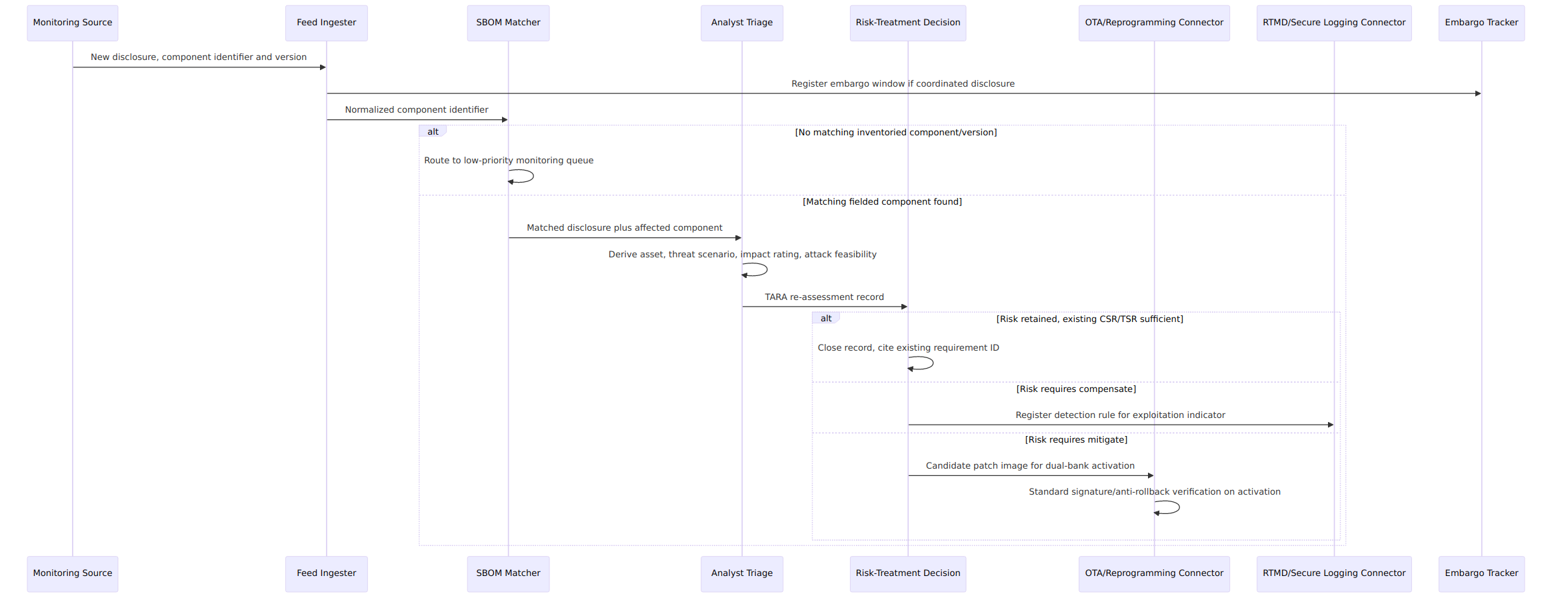
Mermaid source (for editing/regeneration)
sequenceDiagram
  participant Src as Monitoring Source
  participant Ing as Feed Ingester
  participant Match as SBOM Matcher
  participant An as Analyst Triage
  participant Dec as Risk-Treatment Decision
  participant OTA as OTA/Reprogramming Connector
  participant RT as RTMD/Secure Logging Connector
  participant Emb as Embargo Tracker

  Src->>Ing: New disclosure, component identifier and version
  Ing->>Emb: Register embargo window if coordinated disclosure
  Ing->>Match: Normalized component identifier
  alt No matching inventoried component/version
    Match->>Match: Route to low-priority monitoring queue
  else Matching fielded component found
    Match->>An: Matched disclosure plus affected component
    An->>An: Derive asset, threat scenario, impact rating, attack feasibility
    An->>Dec: TARA re-assessment record
    alt Risk retained, existing CSG/TSR sufficient
      Dec->>Dec: Close record, cite existing requirement ID
    else Risk requires compensate
      Dec->>RT: Register detection rule for exploitation indicator
    else Risk requires mitigate
      Dec->>OTA: Candidate patch image for dual-bank activation
      OTA->>OTA: Standard signature/anti-rollback verification on activation
    end
  end
5.4 Behavioral requirement focus
- A disclosure that does not match any inventoried component/version is routed to monitoring only, never consuming analyst triage capacity (CSG-VULN-2, SWR-VULN-2)
- Every matched disclosure produces a full TARA record (asset, threat scenario, impact, attack feasibility) before any risk-treatment decision, not a bare CVSS pass-through (CSG-VULN-3, FSR-VULN-3, SWR-VULN-3)
- Attack feasibility re-rating explicitly cites the TDA4VM-specific hardware fact that changes the generic assumption, e.g. JTAG default state per device security type (TSR-VULN-2)
- A “mitigate” decision is delivered exclusively through the existing dual-bank OTA/reprogramming activation chain, so a vulnerability patch is never trusted more loosely than a routine update (TSR-VULN-3, SYSR-VULN-3)
- A “compensate” decision registers a concrete RTMD/secure logging detection rule rather than remaining a paper mitigation (TSR-VULN-4, SWR-VULN-5 embargo suppression is independent of this)
- Coordinated-disclosure embargoes gate only external communication, never internal risk-treatment progress (FSR-VULN-5, SWR-VULN-5)
6. Hardware-Software Interface (HSI)
6.1 HSI elements
TISCI_MSG_GET_SOC_UID/ eFuse SWREV-KEYREV read-back API (fingerprint interface)- SBOM-to-image-manifest version field mapping interface (shared with the OTA/reprogramming docs)
- RTMD/secure logging detection-rule registration API
6.2 HSI Requirements (HSI)
- HSI-VULN-1: The fingerprint API shall return SWREV/KEYREV and device UID in a format directly consumable by the SBOM matcher without an intermediate manual translation step.
- HSI-VULN-2: The SBOM-to-image-manifest mapping interface shall use the identical version field format as the OTA/reprogramming image manifest, so a “mitigate” decision’s candidate image version is unambiguous end to end.
- HSI-VULN-3: The RTMD/secure logging detection-rule registration API shall accept a rule keyed by the same Data ID/PDU or component identifier used in the risk-treatment decision record, so a compensate decision can be verified as actually active in the field.